


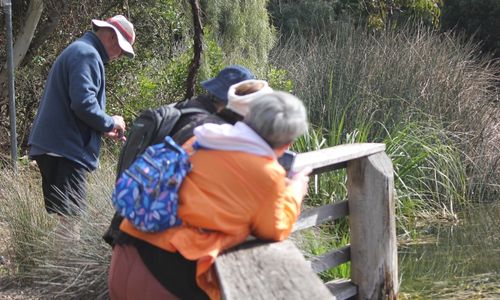
Many people enjoy the outdoors. Getting into nature, either through a leisurely bushwalk or visit to a park, can make you feel good. And citizen science (collection of scientific information by the members of the public) commonly takes people into nature. But are nature-based activities actually good for health and wellbeing, and can citizen science be the tool that takes people ‘into nature’?
The University of South Australia recently completed a study to see whether participation in nature-based activities, through citizen science projects, is good for health and wellbeing.
The research was conducted in two parts.
In the first study, older South Australians, some already involved in citizen science, answered a series of questionnaires about their quality of life, social connections, physical activity and medication use. It was discovered that people already involved in citizen science had lower overall loneliness, highlighting the social benefits of these activities.
The second study was a clinical trial, in which participants with no citizen science experience were allocated randomly to either a citizen science activity group or a control group. All participants completed measures in quality of life, physical activity (using a device worn on the wrist), medication use, before and after an eight-week citizen science trial. This involved a series of weekend nature walks in metropolitan Adelaide where participants made scientific observations using the iNaturalist mobile phone app.
Whilst trial participants showed higher levels of physical activity, the trial period wasn’t long enough to generate more health improvements. Participants enjoyed learning new technologies, learning about natural environments, and contributing to science, in a social setting.
It seems the longer you’re involved, the better it will be for you!
How do I get into nature with citizen science?
The good news is it’s becoming easier to find opportunities to get into nature and contribute to science at the same time.
A few great places to start are:
- Ferox Australis (meaning ‘wild south’) is a not-for-profit organisation that coordinates nature-based citizen science projects
- The SA Department for Environment and Water runs several projects
- The Australian Citizen Science Association SA branch has information about projects too
Findings are from a study by the University of South Australia supported by Office for Ageing Well, SA Health.