


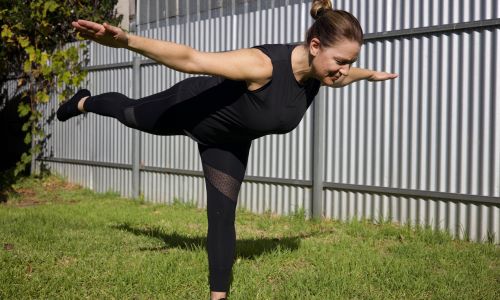
Have you been finding it difficult to stand with your feet not too far apart or get dressed without needing to support yourself?
Do you find you are taking smaller steps and overbalancing when walking sideways or backwards?
“These may be indicators of muscle weakness, tightness, medical conditions or side effects from medication, but they always point to challenged stability. Such signs can be used for self-assessment,” says Mary Voulgarakis, Specialised Exercise Trainer and Older Adult Balance expert in Adelaide.
Everyday life can be demanding and often highlights the importance of good physical condition. Balance is a skill that may decline as we get older, causing difficulties in many aspects of people’s lives. It is important to understand the benefits of good physical balance and how to maintain or even improve it.
These simple balance exercises can be done at home to help regain steadiness.
1. Heel raise
In an upright standing position, lift heels and control when returning to the ground. Use sturdy support if required, without compromising posture.
2. Sit to stand from a chair
Sitting in a chair, back straight, engage feet to push from and stand. Use a cushion on the seat to make it easier as a starting point or use arms to slightly push off the seat.
3. Dorsi flexion
Heels stay down, lift toes, and keep tapping them down, like to the beat of music. This can be done standing or seated.
4. Ankle circles
Turn or rotate ankles in both directions.
5. One leg stand
Using sturdy support if required and good posture, don’t lock knee out. Maintain balance while standing on one leg. Perform with opposite leg. Build up on the duration.
6. Foot self-massage
Using a tennis ball or a trigger point ball, apply pressure on the ball, while rolling it around on the bottom of the foot.
For exercises 1-4, start with as many repetitions you can manage until you can do 10-15. When that’s comfortable, do a second and third set 2-3 times a week. Exercises 5 and 6 can be done 4-7 times a week.
“Any form of exercise can play an important role in reducing stress or depression and in managing medical conditions,” says Mary Voulgarakis.
“Ongoing monitoring of medication dosage and effects, and seeking assistance from a physiotherapist if balance is very compromised, are equally important.
“Improving and maintaining good balance can reduce risk of falls, which could result in fractures. In more than half of the cases in Australia, hip fractures have been shown to impact older adults’ independence and wellbeing. Being steady on your feet will give you the confidence to be more active, physically and socially,” she says.
The Community Care Services (CCS) of the Greek Orthodox Community of SA Inc. (GOCSA) have been working in partnership with Office for Ageing Well, SA Health, to deliver the Ageing Well in CALD (Culturally and Linguistically Diverse) Communities program.
As part of this program, the GOCSA Ageing Well Community Network brings people together in a social setting and promotes health and wellbeing, through exercise, fun activities, and informative sessions by guest speakers.
If you would like to know more about these programs, please contact Greek Orthodox Community Care Services on 7088 0500.
Image: Daphne Bostantzoglou